

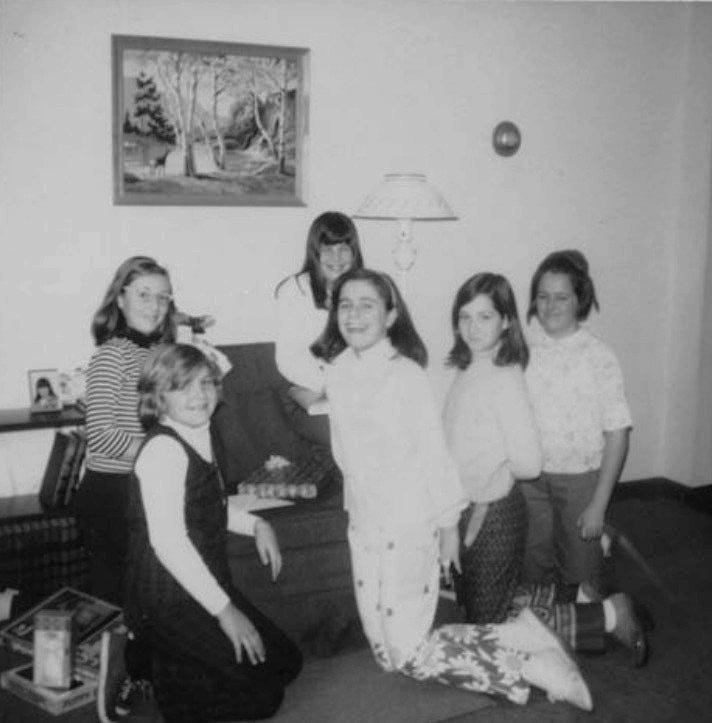
In the old black and white photo, six girls are gathered in Donna’s living room, below a paint-by-numbers picture of a deer grazing beneath some birch trees at the edge of a lake. It’s late November, as evidenced by the pile of birthday presents Donna has been opening just before her mother posed us for the photo.
I’m in one of my growing-out-my-bangs phases, and I’m wearing some sort of bell-bottomed plaid jumpsuit that my mother made, with a zipper up the front, and I have a white turtleneck on underneath.
This was not, I assure you, the fashion, even in 1969. It may be that my mother, despairing of ever getting me into a skirt outside of school or church (where I didn’t have a choice), combined a perfectly normal jumper pattern with a homemade pattern cut from newspaper, perhaps a tracing of my older sister’s bell-bottom jeans, and conceived what she believed to be an appropriate birthday party outfit.
Most of the other girls are dressed considerably more fashionably, especially Veronica, who wears white bell-bottoms with a white blouse. From the knees up, her pants are printed with small daisies, but on the flared lower legs, the daisies grow huge, transforming into a bold and riotous print that can only be described as mod. We are all a little jealous.
Debbie’s bell-bottoms are equally enviable, with a wide border print at the bottom. It’s hard to tell from the blurry photo, but the print might possibly even feature paisleys, my favorite motif at the time. But whether or not they actually have paisleys, her pants are definitely, definitely store-bought.
We all wear saddle shoes or Mary Janes from the Buster Brown store, or lace-up canvas Keds, or, in my case, a pair of knock-off canvas sneakers, the kind you can get for a dollar at King’s, the discount department store in the Milford Plaza.
Despite my lack of stylish attire, I don’t recall feeling like a misfit. In fact, I don’t remember any time during the five years I attended West Main Street Elementary School when anyone picked on me for my unfashionable clothes, barber-shop haircuts (which were, as my mother reminded me, so much cheaper than at a salon), or underdeveloped social skills.
I don’t know if this was a slumber party or not, but if it was, we would have slept downstairs in the finished basement, in sleeping bags on top of air mattresses on the cold, hard floor—white linoleum tile laid directly over the concrete. We would have played games like Truth or Dare, listened to The Monkees on 45 rpm records, and drunk orange soda and eaten M&Ms and Fritos with onion dip. We would have been awake until at least two a.m., and possibly until three or even four, and we would have been groggy and cranky when Donna’s mother woke us around ten to tell us that the first of our mothers had arrived to take us home.
Six months after this photo is taken, my mother will decide to sell my beloved childhood home, just two doors down from Donna’s, in a neighborhood so quiet and safe that we could ride our bikes, or play hopscotch and kickball in the street, without our parents giving much thought to what we were doing. We will move to a much smaller house on a much busier road, only two miles away, but it might as well be two hundred. I will attend a different school, where I will know no one, and life as I have always known it will change dramatically, but I don’t know that yet.
It’s Donna’s eleventh birthday, and, except for me, she is the last in the group to turn eleven. I’m the youngest kid in the sixth grade, due to a series of events that began five years ago, when I was caught reading a third-grade-level book aloud to a circle of kindergarten classmates and suddenly found myself, as a somewhat bewildered five-year-old, in first grade.
I will be ten years old for another three months. I will be barely seventeen when I graduate from high school. Eventually, my youth and immaturity will overwhelm my academic aptitude, and my innate but manageable shyness will blossom into full-blown adolescent self-consciousness that will somehow last until I’m about forty. I’ll never again make friends as effortlessly as I did in elementary school. Among the many bad decisions that lie ahead of me, I’ll drop out of college not once, but three times, and it will take me thirty-one years to finally finish the degree I’ll start in 1976.
But on this day in November of 1969, I’m just one of a gang of happy friends, closer to the world of mud pies, hopscotch, and Easy-Bake ovens than that of make-up, gossip, and mean girls. I don’t even know yet that life can be anything but simple, and ignorance really is bliss.
Even though I am older, the fashion statements were very similar in my day. So many memories from so long ago. I am grateful that I am still in touch with many school friends. I moved hours away for my junior and senior high school years. A whole nother story!
I was also the youngest in the group and yes, it was often a struggle. It took me only 9 years and 3 schools to complete college, however.😁