

“Write the story of a precious possession in your home.” That was the prompt for the September meeting of my online memoir group. In my home I have many precious possessions—too many, as you know if you read my last post here, “The Stuff that Follows Me Everywhere.” Some are treasures passed down to me by my mother, and have special significance because, before I loved them, she loved them first. Others were gifts from my kids, or from friends or relatives, who created or selected something they knew would have special significance to me. But only a few objects that I own today have the distinction of having been mine, and mine alone, for so long that I have no memory of my life before them. These are the things that, it turns out, hold the most intricate memories and long-forgotten details, unlocked only when I sit down to write.
When I come down the steep stairs to the kitchen, rubbing the sleep from my eyes, my place at the round wooden table is already set, with a bowl of cold cereal in the center of the plastic placemat, which is in the shape of a colorful map of the United States. At the top left of the placemat, covering Washington, Oregon, and Idaho, is a small plate for a slice of cinnamon toast, at the top right, centered on the state of Maine, a four-ounce glass of orange juice.
A cheese spread made with pimentos originally came in these tiny glasses, with a pry-off lid, and my mother has collected at least two dozen of them over the years—even though we never have two dozen people in our house, all wanting orange juice at once. But the little glasses, like the larger tumblers that come inside boxes of some brands of laundry detergent, were free, and Mom couldn’t pass up a deal like that. Besides, we all loved the pimento cheese.
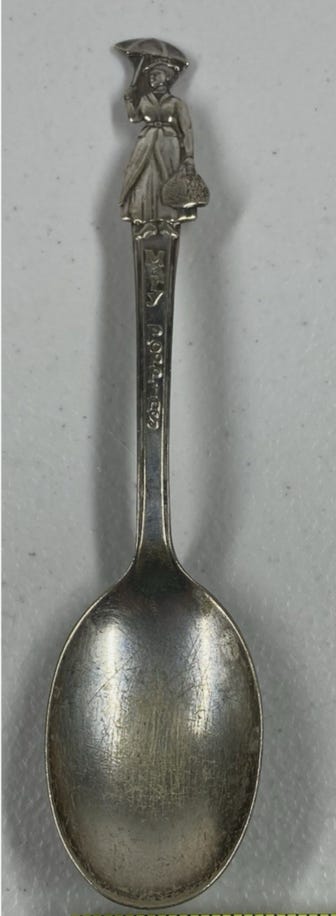
There is a paper napkin, folded into a rectangle, to the left of my cereal bowl, and my favorite spoon, with Mary Poppins and her umbrella on the handle, to the right. The space at the top of the placemat, where Canada lies, is reserved for something special. I take my seat just as my mother places my cinnamon toast, fresh from the toaster, on its plate. I open my napkin, put it in my lap, and look up at her expectantly.
“Here you go,” she says, adding, as she always does, “be careful not to spill.”
With that, she carefully sets the pitcher—my pitcher, the one no one else but me ever uses—on top of Canada, with the handle facing to the right so I can pick it up easily with my right hand, my pouring hand. Unlike my older sister, who has learned to do many things well with either hand, because the world hasn’t yet changed quite enough to easily accommodate her left-handedness, I am solidly right-handed, and my left hand is clumsy. If I had to pour my milk with it, I’d almost surely spill.
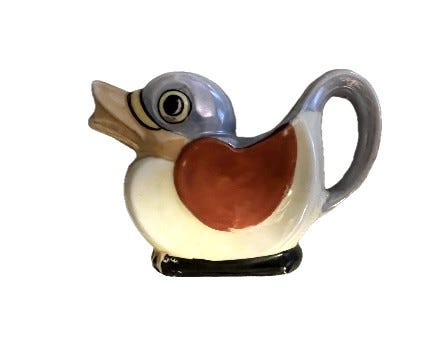
My pitcher is in the shape of a bird, blue and yellow, with a red wing; its tail is the handle and its beak is the spout. It holds just enough milk to pour onto a child-sized serving of cereal, and I am very proud that it is all mine, and to be trusted to pour from it all by myself.
In general, my mother doesn’t believe in sugared cereal for breakfast, although once in a while she relents, and buys the variety pack of miniature boxes, the kind you can cut open with a knife along perforated lines, then fold back the flaps and pour the milk right into the waxed paper-lined box. So I know all about Frosted Flakes and Tony the Tiger, Froot Loops and Toucan Sam.
I do like all the unsweetened cereals she buys for us, though. Each kind reacts differently when I pour the milk onto it from my bird pitcher. If I have Grape Nuts in my bowl, I pour the milk and then wait a couple of minutes, eating my toast first, to give the hard little nuggets time to soften up a little. If it’s Puffed Wheat, with the picture of a Quaker man on the box, it floats on top of the milk, sometimes rising right up until it spills over the rim of my bowl. But my favorite is Rice Krispies, because when you add milk, they go “snap, crackle, pop!” I put my ear down close to the bowl to hear them talking to me.
More than sixty years later, the little bird pitcher is still one of my most cherished possessions. As a child I always thought it must be one of a kind, that I had the only one in the world, but a quick Google search reveals that it is a fairly common vintage piece of lusterware, made in Japan and readily available on eBay for under $15. It was originally sold as a creamer, part of a set that also included a similar sugar bowl.
My older brothers say they don’t remember having the bird pitcher as kids, although Greg adds that he has a vague memory of a chicken creamer used by them the same way. “Probably one of us broke it before you came along,” he says.
My sister remembers using it to pour syrup, “but it may not have been around when we older siblings were little. Mom may have picked it up at a yard sale for you to learn to pour.” Also, she calls it a “duck pitcher.” I’ve always thought it was a bluebird, but now that I look at it more closely, she may be right.
With no more rambunctious little boys in the house, my mother kept my bluebird (or duck?) pitcher safe for the rest of her life, and when she died, it was passed down for me to keep. It now sits on a high shelf in my kitchen, safe from counter-surfing cats and bungling husbands, a tiny treasure from my distant past.
Lovely Memories. I'm smiling.
Stick with bluebird, as it ever was.