

This month, when my writing group was given the prompt, “What place in nature holds the most special meaning for you? Why?”, I didn’t have to think very hard about my answer. How lucky am I to have had, from my earliest memory, my very own mountain?
I am lying on Buck’s Ledge, feeling the curve of the earth in the sun-warmed rock beneath my back. Here and there, in the crevices of the granite, enough soil has accumulated for patches of soft moss to grow, and I am resting my head on one of these, while my heels are braced lightly against a small outcropping of rock.
If I turn my head I can see, inches from my eyes, three different varieties of moss. I search lazily through my mental catalog to see if I can name them all, but I can only remember that the tallest one, with its delicate stalks tipped with brilliant red, is called something like British soldier moss.
It is summer, and I have climbed Moody Mountain to see if the blackberries are ripe, and if perhaps I might see a deer or even a moose in the cool, swampy spot behind the ledges that never quite goes dry, even in August. But there are no deer trampling the dark mud today, and no moose, and if there were any ripe blackberries, a bear has gotten here before me and cleaned them out, leaving behind black scat that is pebbled with seeds.
I don’t mind, because really, I came here to do just what I am doing, to lie on the bare rock that is like a portion of the earth’s skeleton exposed, closing my eyes, imagining I can feel the earth’s slow rotation, and opening them to look at the dome of the sky stretching over me and down to the horizon.
I have spent every one of my 67 summers on the eastern shore of North Pond in Woodstock, in a rustic camp my parents and teenage brothers built in the 1950s. The foot of Moody Mountain is the shoreline, and the sheer granite face of Buck’s Ledge looms above the pond, at various times reflecting the late-afternoon sun, revealing the rising moon, or shimmering in a morning mist.
When I was growing up, we called it simply “the mountain.” If, as we finished washing the breakfast dishes on a perfect summer morning, my mother suggested that we climb “the mountain,” I knew she meant Buck’s Ledge. No summer at camp was complete without a trip up to pick a few blueberries, check on the wildlife in the swampy area behind the ledge, and enjoy a picnic overlooking North Pond.
When I was old enough to make the climb by myself, I spent hours there alone. I often brought along a book, or a notebook in which to scribble my angst-ridden teenage poetry. Sometimes, I simply lay back on the sun-warmed granite and closed my eyes to feel the motion of the planet beneath me.
In those days, the only way up was a short, steep ascent—half trail, half bushwhack—that originated behind our camp and ended abruptly at what is inarguably one of the best “bang-for-the-buck” views in western Maine.
Now, thanks to the vision and hard work of the members and supporters of the Buck’s Ledge Community Forest Committee, well-marked and maintained trails lead to Buck’s Ledge. Connecting trails to the east-facing Lapham Ledge and the open “true summit” of Moody Mountain offer several miles of varied terrain to explore, and three very different viewpoints to savor.
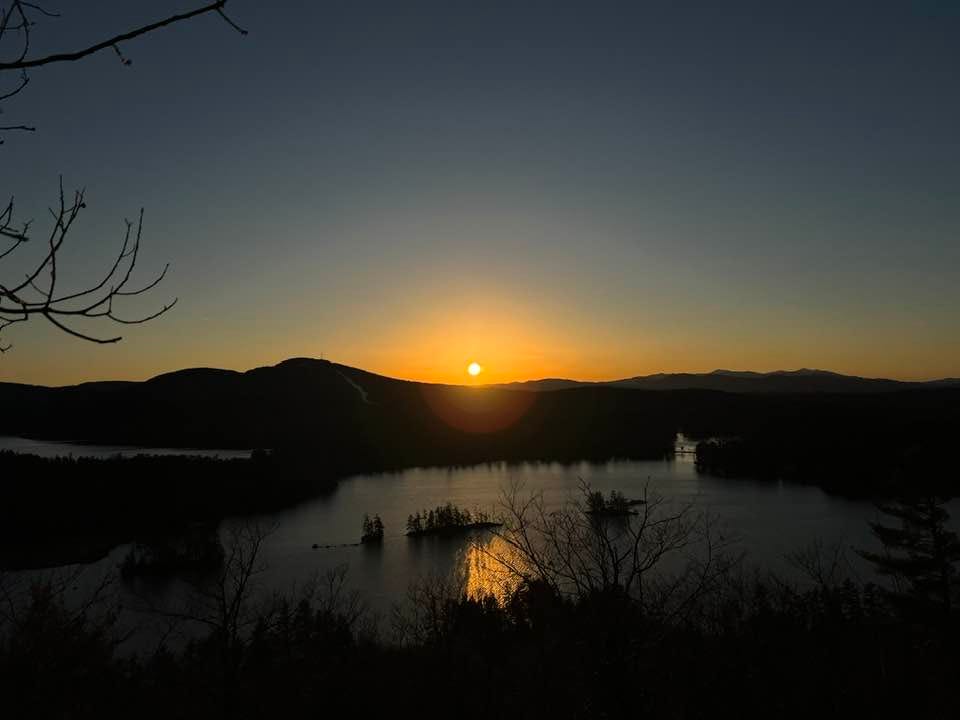
Accessible in all seasons, this trail network provides me with nearly unlimited opportunities for outdoor recreation and exploration. Early spring sunrises from Lapham Ledge are magnificent. From Buck’s Ledge, no two sunsets are alike, and when the fall foliage is mirrored in the water of the ponds below it turns them to liquid fire. The snow-capped Presidentials, as seen from the summit of Moody Mountain on a bluebird-sky winter day, are breathtaking.
Even after hundreds of hikes on “the mountain,” I marvel at how fortunate I am to have it right here in my own backyard, and at what a joy it has been to introduce first my own children, and now my granddaughter, to this wild, unique, and irreplaceable corner of the world.
I love this! Just yesterday morning, in the beautiful sun, I had the opportunity just yesterday to hike at Greenwood’s Maggie’s Nature Park.
We chose the yellow loop, which offers a spectacular view from the ledges.
Truly a wonderful place!
And one that has been blessed with people who recognize, appreciate, and have preserved these areas.
I too have a special spot in my soul for that pond and that mountain. When I think about home that is where my thoughts go first.