

Thank you to my fellow writer Bonnie, whose prompt for our writing group this month—“What person or experience hurt your spirit most in this lifetime? How did this affect you?”—prompted me to think back to the hell on earth that was junior high. I’ve written about that time before, and I could probably write a whole book about those miserable two years. So I was inspired to dig out an essay I had written and posted on a previous blog 12 years ago, rewrite and expand it to more than twice its original length (yep, it’s long), and post it here.
Yesterday, for the first time in a long while, I opened a can of Campbell’s vegetable beef soup, and I was transported, abruptly and with remarkable clarity, straight back to junior high. If I’d peeked into a mirror, I would have expected to see a sullen round-faced girl in gold wire-rimmed glasses, with frizzy long hair parted down the middle.
Seventh grade was the worst. The seventy or so kids in the Mathewson School seventh grade had all gone to school together, as nearly as I could tell, from the first day of kindergarten, seven years ago. At the very least, they had all been together the year before, in the sixth grade. And it soon became apparent that at Mathewson School, sixth grade was when the girls grew several inches in height, started shaving their legs, and began to wear makeup and bras, and I had completely missed the memo.
Across town at West Main Street Elementary, where I had gone to school for five years, and where all of my friends still went, sixth grade had been, for the most part, a continuation of fifth grade, which had been a continuation of fourth grade, and so on.
The girls still played jump rope at recess while the boys played football or did whatever it was that boys did. In gym, we went outdoors and played kickball or dodge ball in the spring and fall. In the winter we stayed indoors and played volleyball, or do-si-do-ed around the gym with boys with sweaty palms, simultaneously intrigued by the hard, corded muscles in their skinny arms and vaguely repelled by their foreign scent and inelegant Adam’s apples.
We still sang “The Erie Canal” and “This Land Is Your Land” in music class and did the same art projects with glitter or cotton balls or crumpled tissue paper when the art teacher came to our classroom on Friday afternoons, although nobody tried to eat the paste anymore when the teacher’s back was turned.
Certainly my sixth grade year had had its share of mild emotional upheaval. But most of it had resulted from getting my first B on my report card (in math), or from losing the election for class president to a boy whose father had been elected as the city’s mayor just two weeks earlier, and who was therefore in a position to pass out leftover bumper stickers and real metal campaign buttons. Meanwhile, I worked feverishly to produce lopsided circles of oak tag, haphazardly lettered with “Vote for Amy,” and urged my friends to Scotch-tape them to their shirts.
One of my central campaign promises—to fight for the right of girls to wear pants to school in the winter instead of dresses—notwithstanding, even the girls began to duck their heads, refusing to meet my eyes, when I asked if they’d help me hang my crayoned construction paper posters on the bulletin board. In the end, even my campaign manager defected, seduced by a bumper sticker, a button, and the prospect of a post-election pizza party at city hall for the entire rival campaign team.
I don’t remember how badly I lost the election, or even if I got any votes at all, besides my own. But what I do remember is that the failure of my campaign didn’t ruin the rest of the year, because my sixth-grade classmates at West Main Street School were, overall, just a nice, kind bunch of kids. Cliques were nearly nonexistent and grudges rarely held. Besides, the office of class president turned out to be almost completely inconsequential once we finished up our social studies unit on government.
There was one thing about sixth grade that rankled, though. At the end of the previous school year, in a heinous incidence of collusion among the fifth and sixth grade teachers, my best friend, Donna, and I had been deliberately separated for the second year in a row, so she was in the other sixth grade classroom, across the hall. We saw each other before school, at lunch and recess, in gym class, and every day after school. Still, I felt a persistent sense of injustice, and, off and on, an undercurrent of anger at authority throughout that year.
Donna and I had met at the beginning of second grade, when we were both new to West Main Street School, and had been in the same class throughout second, third, and fourth grade. We lived two houses apart on Marshall Street, and we were pretty much inseparable. We were also creative, funny, and spirited. We wrote books together, invented detailed games of imagination, and built elaborate forts and intricate ant cemeteries. We had a fairy friend named Robin, and we were making rustic fairy houses of pinecones and twigs, furnished with milkweed pod beds, decades before it became all the rage.
What we were not was exclusive, mean, or disruptive. We both had other friends, we played well in a group, and about the only things we ever got in trouble for were whispering in class and passing notes.
But we were living in a time and place that placed a high value on conventional behavior and aspirations, especially for girls. Learning to conform to acceptable standards was seen as far more important than nurturing our creativity. There may have been a cultural revolution happening somewhere, but in suburban Connecticut in 1968, no one was “letting their freak flag fly.”
As Donna said recently, “Today we’d be described as ‘spirited’ and ‘imaginative.’ We weren’t getting into trouble, and there was no good reason we should have been deliberately separated. But even though the ‘60s were a time of big change, there was still no place for spirited, imaginative young girls.”
When I’d learned, on the last day of fifth grade, that we were to be separated again the following year, I’d quite uncharacteristically thrown a temper tantrum and tipped over my desk, frightening my 23-year-old teacher enough to send her scurrying to the other fifth-grade classroom to fetch Donna to calm me down.
Although I rarely got into major trouble at school, and I don’t think my mother ever even heard about the desk-flipping tantrum, she kept a close eye on me throughout my sixth grade year and, apparently, began to grow concerned over what she saw as my increasing nonconformity.
I’d gradually managed to overcome my innate shyness, and, even without sharing a classroom with Donna, in sixth grade I found a comfortable niche as a sort of smart mouth/class clown/eccentric kid. I was starting to figure out who I was, and I confess that I loved the attention I was getting. But my mother, who had managed to raise my four siblings without receiving a single dreaded “note home from the teacher,” and who had never before seen words like “unconventional” and “headstrong” in report card comments, was certain I was headed for a future as a juvenile delinquent.
I once overheard her tell one of my older brothers that I was becoming “hard to control” and had gotten “too comfortable”—as if a certain level of discomfort was considered appropriate for keeping a nascent eccentric in line—and she worried about what would happen if she didn’t nip this new behavior in the bud, something best accomplished, she thought, by “getting me out of that environment.”
She had already decided to put our four-bedroom house on Marshall Street on the market, now that I was the only child left at home. There were certainly smaller houses for sale within the same elementary school district, but as far as I know she never looked at any of them when she went house-hunting with a real estate agent one Saturday morning.
The only house I was taken to see was a red two-bedroom ranch with a postage-stamp-sized lawn on West River Street, in a different school district. My mother called it a “doll house” and deemed it perfect for us. I found it cramped and uninteresting, devoid of the dozens of nooks and crannies and private spaces in and around our Marshall Street house, with its one-acre lot that I had turned into my private world. It also smelled funny, like a place to visit, not a home.
So we moved, and I left the neighborhood where I knew every family, and the school where I knew every kid and every teacher, and started seventh grade in a school where I knew no one.
Although the schools were only a couple of miles apart, the kids at my new school, for whatever reason, were light-years ahead socially. There were cliques and alliances, romances and break-ups, constant whispered intrigue. It might as well have been another country as far as I was concerned, with its own language and a whole new set of customs.
To make things worse, my mom was the school librarian, a fact that meant I was destined from the start to become a social pariah. Her position made her enough of an authority figure to get kids in trouble for acting up in the library, but not enough of one to command much actual fear or respect.
Some of the kids called me “Mrs. Wight’s Daughter” for the entire two years I attended Mathewson School, not bothering to learn my name, and said clever things like, “Hey, Mrs. Wight’s Daughter, do you read a lot of books?” and “Hey, Mrs. Wight’s Daughter, do you live in the library?”
Also, it turned out that I had really bad fashion sense, something that had gone completely unnoticed at my old school. My skirts were too long, my pants were too short, I still wore knee socks instead of panty hose and, worst of all, white undershirts with tiny satin bows at the neckline instead of bras.
And I had the world’s bulkiest and most ridiculous navy blue fake-fur coat, something I’m sure I chose for myself, but which I now realized—too late, because my mother had bought it big enough to last at least two winters—was a terrible mistake.
The mean girls took to calling me “Fuzzy Bear,” which was not really an improvement over “Mrs. Wight’s Daughter.” I spent most of my time at school trying not to be noticed, no small feat when you’re the only kid in sagging knee socks and navy blue fake fur.
Every day, in order to avoid the possibility—who was I kidding? the probability—of having no one to sit with in the cafeteria or hang out with on the playground, I walked the half-mile home and heated up a can of Campbell’s soup for lunch. I had forty whole minutes of freedom in the middle of every awful day, and I took advantage of every one of them.
It took me nine minutes to walk each way, counting the cracks in the sidewalk, reciting poems I’d memorized, and making up stories in my head. (In fairness to the kids at my new school, it’s possible that I might not have fit in much of anywhere in seventh grade.) That left me twenty-two glorious minutes alone at home. I hated our new house almost as much as I hated my new school, but at least it was quiet and empty in the middle of the day.
I got to use my own bathroom, without the risk of encountering any of the mean girls in the school lavatory. I got to sit at our little round kitchen table, and read a book while I ate. Since my mother wasn’t home to object, I could let my cat sit on the table for company. It was the best part of my day.
Although that move across town, coming as it did at exactly the wrong time in my adolescence, dealt a severe blow to my confidence and self-esteem, it’s very possible that those forty-minute daily escapes turned me into the person I became. They led me to embrace solitude, accept my quirks, entertain myself, get lost in books, and count on cats for companionship, all things that are still important to me.
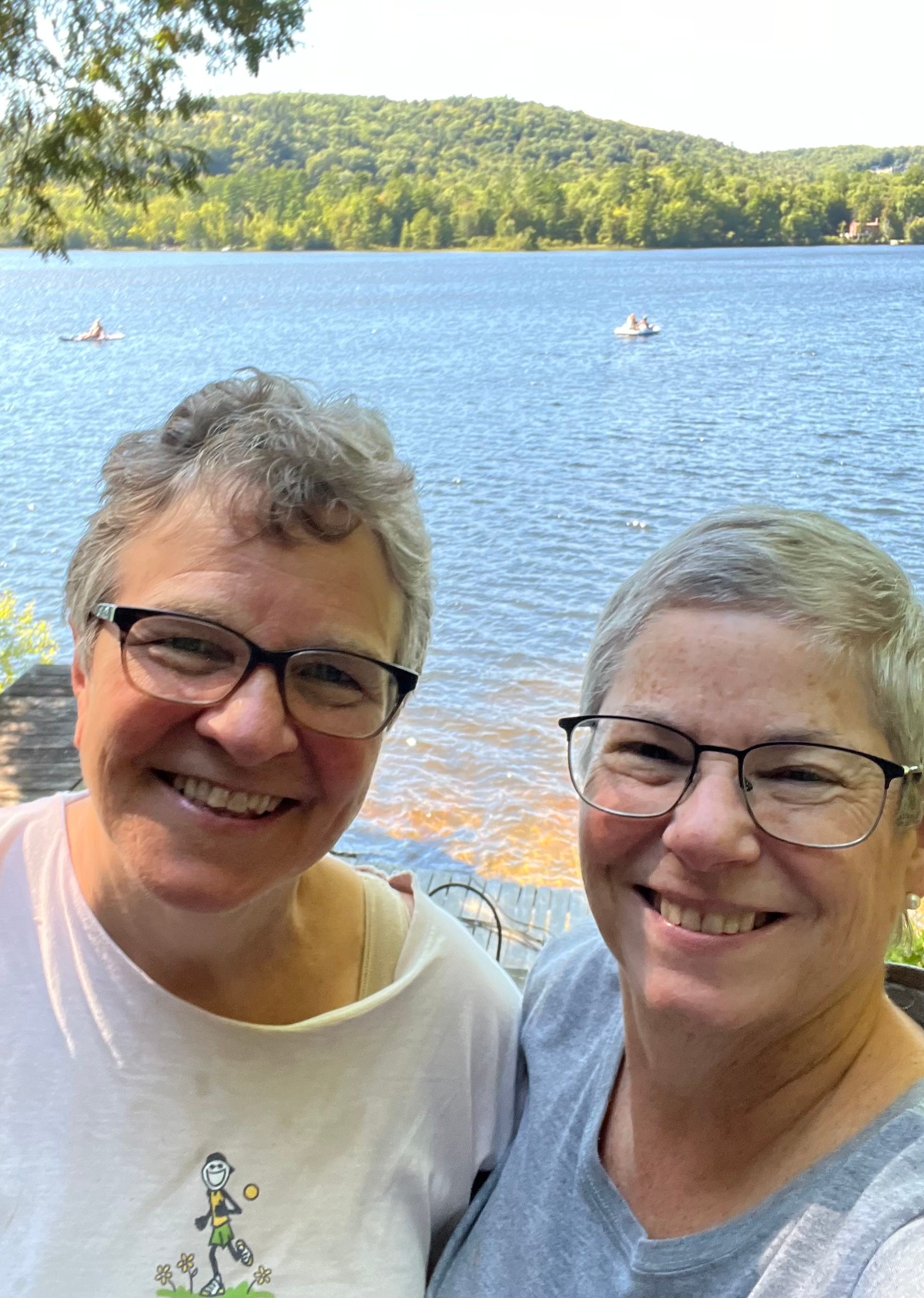
Defying the odds and the deliberate attempts to separate us, Donna and I have remained best friends all of our lives. For more than six decades, we have shared a deep conviction that high spirits and creativity are traits to be nurtured, not squelched, and that unconventional kids grow into extraordinary adults. This weekend, we’ll travel back to Milford together for our 50th high school reunion. No one knows me better, and no one embraces my quirks more wholeheartedly.
And even though I eventually became a pretty good cook, and learned to make pots and pots of really good homemade soups, sometimes a mug of Campbell’s vegetable beef still really hits the spot.
Sixth grade seems to have been a pivotal year for many of us. For me, "mean girls" pushed my kindness button and I think it is still on. Not a bad result for the rest of my life. Though I am still very aware of cruelty.
Yeah, seventh grade was the worst for me, too. I was separated by some clerk of the school department and sent to school I knew a couple of people who were not in my classes. It was a pivotal time.